Archive for the ‘PayPerPost’ Category

Pay Per Post: No back to back sponsored posts.

Wednesday, September 5th, 2007

Pay Per Post has recently clarified its TOS: Posties can no longer post back - to - back sponsored posts from any company. This means Posties blogs cannot post series of posts as follows:

PPP Sponsored - unsponsored - PayU2Blog - Bloggerwave - Blogitive - unsponsored - PPP sponsored - unsponsored - Smorty - PayU2Blog- unsponsored - PPP sponsored.

The several back-to-back sponsored posts from any company now exclude a blog from participating in PPP.

Is this really a change?

Maybe not. I interpreted the PPP’s previous TOS, and previous discussions at the forum, to prohibited back-to-back sponsored posts from any company. However, it appears some posties believed otherwise and were posting back-to-back posts quite regularly. Clarification was required and the TOS have been rewritten to make this policy absolutely unambiguous.


Better ROI for advertisers.

In my opinion, this is great for advertisers because they will probably see:

  1. More traffic: Your sponsored post is less likely to quickly roll off the front page of a blog that posts a flurry of posts containing inexpensive paid links. This means more blog visitors will see and read the post you pay for; if the post is well done, it means more traffic.
  2. More relevant audience: Generally speaking, niche bloggers are better able to retain their flavor when the proportion of paid posts is low. For example, my knitting blog cannot retain a knitting audience while carrying 50% posts on insurance, gold coins, mortgages or even slenderizing treatments and remain a knitting blog. So, advertisers who picked my blog because they wanted an audience of mostly college educated women with leisure time are more likely to get what they want if I carry relatively few ads.
  3. More link juice: Google and search engines are somewhat less likely to devalue the “trust” rank of a blog that shows fewer than 1 paid post out of two rather than over 75% paid posts.

In short, this will result in better returns on investment for advertisers.

Hopefully, this will also translate into better fees for the low-ad intensive blogs in PPP’s marketplace.

What about Bloggers?

Well, this will clearly cramp the style of bloggers who were running back-to-back sponsored and intended to continue. If you were planning to monetize that way, you will either need to conform to PPP’s TOS or resign from PPP. Conforming will involve either taking fewer PayU2Blog paid links or doing a additional work to crafting additional un-sponsored content to space between the PayU2Blog posts or starting a few “back-to-back sponsored posts” blogs on which to run ads from the less restrictive pay-to-post services and getting them qualified by the other services.

So, if you want to run back-to-back posts, you have some options.

For bloggers who never ran back-to-back sponsored posts, the policy clarification will have little direct impact. However, it may have an indirect impact if advertisers prefer to shop in a marketplace full of blogs containing a lower fraction of sponsored ads.

I’m guessing advertisers will prefer the low-ad blog market place. If so, we’ll advertising opportunities for a wider variety of products offered with higher fees.
PPP & Argus: Great Leap Forward

Tuesday, September 4th, 2007

Hey, serious bloggers. Pay Per Post has a new innovation, and it may be time to sign up. (And I’m saying this as someone who is not currently a postie and may have trouble persuading them to let me back.)

Pay Per Post is now set up to reward blogs with real traffic!

Of course, in some sense PPP always rewarded blogs with traffic. However, they used Alexa to measure traffic, and it’s so bad that this blog shows more traffic than my knitting blog — which gets 10 times the traffic I get here!

But Alexa will now provide real traffic monitoring.

How? On Sunday, PPP announced Argus, a monitoring system that will:

  1. Make it easier for advertisers to find suitable bloggers to carry ads and
  2. Provide actual traffic data to advertisers surrounding visits, pageviews, click throughs, traffic sources.

This tool uses the javascript installed in the footers at Postie blogs.

(Knowing you can track with Javascript, I’d been hoping they were planning this. Turns out they must have been!)

Evidently, PPP will still use Alexa as a traffic indicator to supplement their data. Still, presumably, if real traffic metrics exist for blogs, advertisers will quickly turn to the more suitable measurement — which is certain to be the PPP data.

In my opinion, Argus is a great advance all around. The advantage to advertisers is obvious. Though less obvious, Argus also has great advantages for serious bloggers who wish to monetize.

Advantage to bloggers

Bloggers will also benefit because a real traffic monitoring system will:

  1. Permit high bloggers real traffic to attract the higher priced opps. Previously, it was the heavily gamed “Alexa” traffic that won the higher pay.
  2. Allow posites to stop wasting time creating blog rolls that they auto visit armed with “Linky” and “Alexa” Firefox tool-bar extensions.
  3. Encourage posties to devote themselves to building real traffic by writing great blogs!

Great work to the Pay Per Post team! Hopefully, other companies will follow your lead and start using real data too.

The Secret to Getting Vistors who Click Ads.

Wednesday, July 11th, 2007

Do you have decent traffic, but low returns on pay per click programs like Adsense or Kontera? Well, you may be working very, hard to attract visitors who will never click on your ads!

After all, people surfing the web click on ads under certain circumstances which include:

  1. The ad is targeted to their interest.
  2. They are in an ad-clicking mood.

Read this again: Visitors click ads only if they are in an ad-clicking mood.

So why might this be a problem for you? Well, if you are working hard to monetize your blog, you may be engaging in a number of practices to boost your traffic. I know I am.

So far, that’s ok. But did you know some of the methods to boost traffic will result in low click through rates - - at least in the short run.

Mind you, the methods may result in clicks in the long run- but only if you can convert these visits into what you might call “natural” traffic.

So, what type of traffic isn’t “natural”? It’s first generation traffic that arises as a direct result of some traffic boosting methods. For example, it could be traffic from a “dofollow” list, or traffic from requesting Posties to digg your post on the PPP board.

Why “Dofollow” traffic doesn’t click.

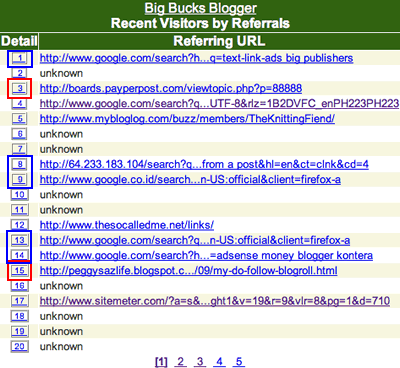
Let me give an example of traffic that won’t generate clicks. To encourage traffic, you might have added your blog to a “DoFollow” list. I have, as you can see from the blog stats for BigBucksBlogger, visit #15 came from someone’s DoFollow list.

Quality Traffic

Frankly, I’m very happy to get that traffic.
Nevertheless, there is no point in deceiving myself into believing visitor #15 was likely to click on an ad. They probably wouldn’t because:

  1. Most dofollow visitors are uninterested in ads associated with my blog niche. Period. At my knitting blog, I’m pretty darn sure practically no one visiting from the dofollow list is fascinated with knitting; these people aren’t clicking ads to buy yarn.
  2. The “dofollow” visitors are not in an ad clicking mood.

The second point is actually the more important of the two.

Think about this: When people decide to use their dofollow blog rolls, they are focused on reading posts, thinking up a fairly relevant comment and dropping a link to their blog. Generally speaking, they aren’t going to do anything to distract them from the task at hand which is visiting a bunch of blogs and leaving a bunch of links.

They don’t click links in ads.

There are other sources of traffic that is fairly unlikely to convert to links: People who you asked to visit and click your Digg button. People who clicked signature links at webmaster forums; they are curious but often aren’t all that interested in buying products in your niche. (I ask you, how many at webmaster forums are interested in knitting? I’m sure they didn’t click ads!)

Should you stop trying to attract “Dofollow” traffic?

Still, there is a very good reason to stay on dofollow lists, to visit appropriate forums and to at attract traffic even if it’s non-ad-clicking traffic. The fact is, if you write good content, some of this traffic will eventually result in “natural” traffic.

How? Well, even though I skim when I visit dofollow blogs, I also bookmark the blogs that contain content that interests me.

Later, I return and read more. Believe it or not, I’ve even written whole blog posts as a result of articles I wandered across on the dofollow list. I’m sure other people using the dofollow list do the same.

This means that if you write content that interests some visitors, you will find that eventually a few of the dofollow visitors will come back. Since many of those dofollow visitors are bloggers, they may even be inspired to write a post, link your blog and leave you a trackback.

This will increase your visibility with search engines and eventually bring in “natural” traffic. When that happens, your blog will see ad-click rates rise. This is because there is a certain category of visitors who click on ads at a higher than average rate.

Search Engine Visitors Click Ads

Yes, visitors doing searches tend to click on ads. Not only are they interested in your topic, they are interested right now. After all, if they just Googled for advice on “topic X” , you can be pretty sure they are on a mission to learn more about “topic X”. That means they are fairly likely to click an ad about “topic X”.

Now, you have visitors how are in the mood to click ads and you will start to make money. And what was the secret?

Write valuable content!